
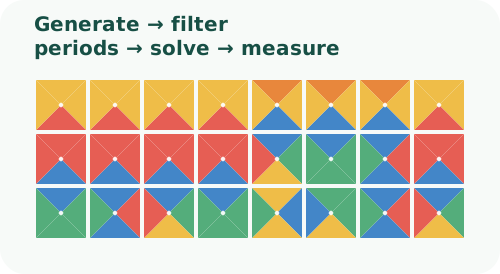
Hard puzzle generation is a search over two coupled objects: a protoset and a solved board. A promising tile catalog can yield a trivial board, while an interesting-looking board can be easy because one local choice forces everything else.
Generate a candidate solution first
Wang World constructs a complete matching board, derives the prototypes used by that board, and then asks whether the resulting puzzle meets the requested rules and limits. Starting from a solution prevents wasted time on obviously impossible random catalogs.
Reject short periods
Candidate protosets are tested for small horizontal and vertical periodic tilings. Sets admitting very short periods often generate repetitive boards with interchangeable regions. Rejecting them is a fast heuristic inspired by aperiodic tile research. It does not establish aperiodicity; it merely directs expensive search toward less repetitive local systems.
Beyond rectangles: polyomino periods
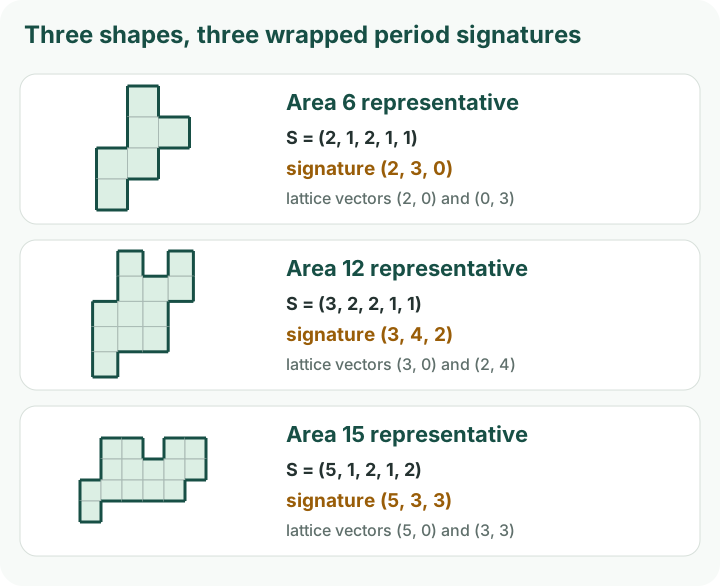
A repeating patch need not use an axis-aligned rectangle as its fundamental domain. Wang World also wraps specially constructed polyominoes: connected unions of unit squares whose translated copies cover the plane. The family starts with a rectangular body, moves a two-row strip one cell to the right, removes one cell from the strip’s outer row, and restores one cap cell at the opposite end. The result still has area A = width × (height1 + height2), but its vertical return may be sheared.
One signature for each wrapped topology
Write w for the width, H = height1 + height2 for total height, and q = offsetX + dentX. The period lattice is generated by (w, 0) and the sheared return vector (q, H). Its wrapped square-adjacency structure depends only on (w, H, q mod w). Shapes with the same signature can look different on paper while imposing equivalent boundary contacts, so only one representative needs a backtracking test.
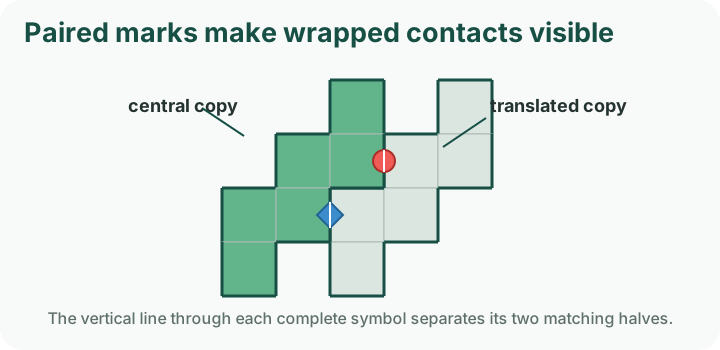
Before scoring a candidate, the search checks whether its tiles make small repeating patterns. Candidates that repeat too easily are discarded, allowing the search to concentrate on puzzles more likely to provide an interesting challenge.
Apply the complete rule model
The generator and solver must agree about rectangular dimensions, Loop topology, rotations, fixed walls, wildcard counts, finite prototype inventory, Shuffle, Rotation Only, Mental restrictions, and atomic Linked Tile groups. A candidate measured under a simplified rule would receive a misleading score.
Measure, then verify independently
Surviving candidates receive a deterministic Complexity measurement. Selected puzzles are independently verified before publication.
Human review still matters
A high numerical result may be ugly, repetitive, or dominated by one arbitrary guess. Competition candidates are checked for mode variety, visual clarity, prototype use, accidental isomorphism with existing puzzles, and reasonable solve time. Private submissions are isolated until accepted.
For the metric itself, continue to Puzzle Complexity. For the mathematical motivation behind period filtering, revisit Aperiodicity.