
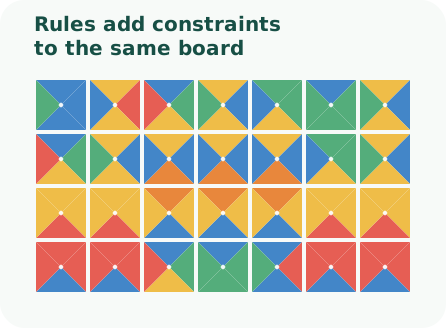
Every Wang World puzzle starts with one rule: colors must agree across shared edges. The mode label then lists only the extra rules that modify movement, inventory, topology, or information.
Board topology
On an ordinary open board, edges facing outside the rectangle are unconstrained. Loop joins opposite boundaries: the top row must match the bottom row, and the left column must match the right column. The visible ghost borders help trace those wrapped contacts.
Orientation rules
Rotate permits quarter-turns but never reflections. Rotation Only fixes which prototype belongs in every playable cell and asks only for orientations. Rotation Only therefore has no palette-placement problem and cannot be combined with Shuffle, Wildcard, Mental, or Linked Tiles.
Walls and holes
A wall occupies a fixed cell and has four sides. A colored side must match its neighboring tile. A side marked ? is a hole and accepts any adjacent color; a contact consisting only of unrestricted holes supplies no hint. Several walls can partition a rectangle into chambers while the tile inventory remains globally shared.
Inventory rules
A finite counter limits all orientations of that prototype together. Parked and board tiles both consume supply. A Wildcard matches every color and has a finite count. Shuffle begins with a complete finite board inventory: movement is swap-only, so every supplied item remains present.
Mental and Linked Tiles
In Mental mode, a placement is a commitment and Clear is the only restart. Linked Tiles mark two or more positions with the same colored center window. Placing or rotating one member synchronizes the entire group. Outside Mental mode, moving a linked tile clears its complete source group and transfers one copy.
Combinations
Most rules combine freely. Linked Tiles work with Loop, Rotate, Mental, Walls, Wildcard, and finite supply, but not Rotation Only or Shuffle. Mental excludes Rotate, Rotation Only, and Shuffle. The New Puzzle dialog disables incompatible choices rather than creating ambiguous games.
Apply these rules in the guided Tutorial or see how rule combinations influence Complexity.