
Learn · Explore · Play
Wang Tiles Encyclopedia
From Hao Wang and the domino problem to modern aperiodic sets and practical puzzle strategy. Read in order or choose a topic.
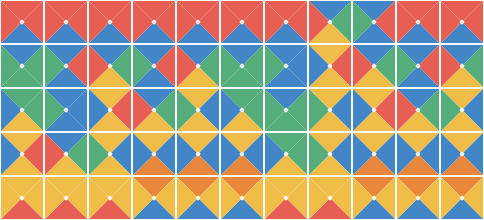
Wang Tiles
How four colored edges led from a decision problem to aperiodic order, symbolic dynamics, and a durable language for puzzles and computation.
Article 2Wang Tile Puzzles
A practical and mathematical guide to finite boards, solving tactics, uniqueness, inventories, and the difference between a puzzle and an infinite tiling problem.
Article 3Aperiodicity
What periodicity means, how small aperiodic Wang sets force hierarchy, and how finite computation helps reveal structures that no translation can preserve.
Article 4Applications of Wang Tiles
From texture synthesis and procedural worlds to DNA self-assembly, symbolic dynamics, and models of computation.
Article 5How to Play Wang Tiles in Wang World
Choose a puzzle, read the protoset, place tiles, resolve mismatches, and complete a board whose every shared edge agrees.
Article 6Wang World Puzzle Rules
A reference for Open and Loop topology, Rotate, Rotation Only, Walls, Wildcards, Shuffle, finite inventories, Mental mode, and Linked Tiles.
Article 7Searching for Hard Wang Puzzles
How Wang World generates candidates, rejects repetitive protosets, solves boards, measures search effort, and promotes only carefully reviewed results.
Article 8Puzzle Complexity in Wang World
Why elapsed time alone is not a puzzle property, what forced-mrv-v2 counts, and how deterministic contradiction search becomes a stable difficulty signal.
Article 9Wang World Competition
Protected attempts, authoritative timing, server-side solution checks, score calculation, and leaderboards designed to compare like with like.
Article 10The Wang World Game Tutorial
Eleven deterministic lessons that build from ordinary placement to topology, constrained inventories, Linked Tiles, and Directional edges.